
Your Soft Skills Problem is Actually a Class Culture Clash
July 8, 2026
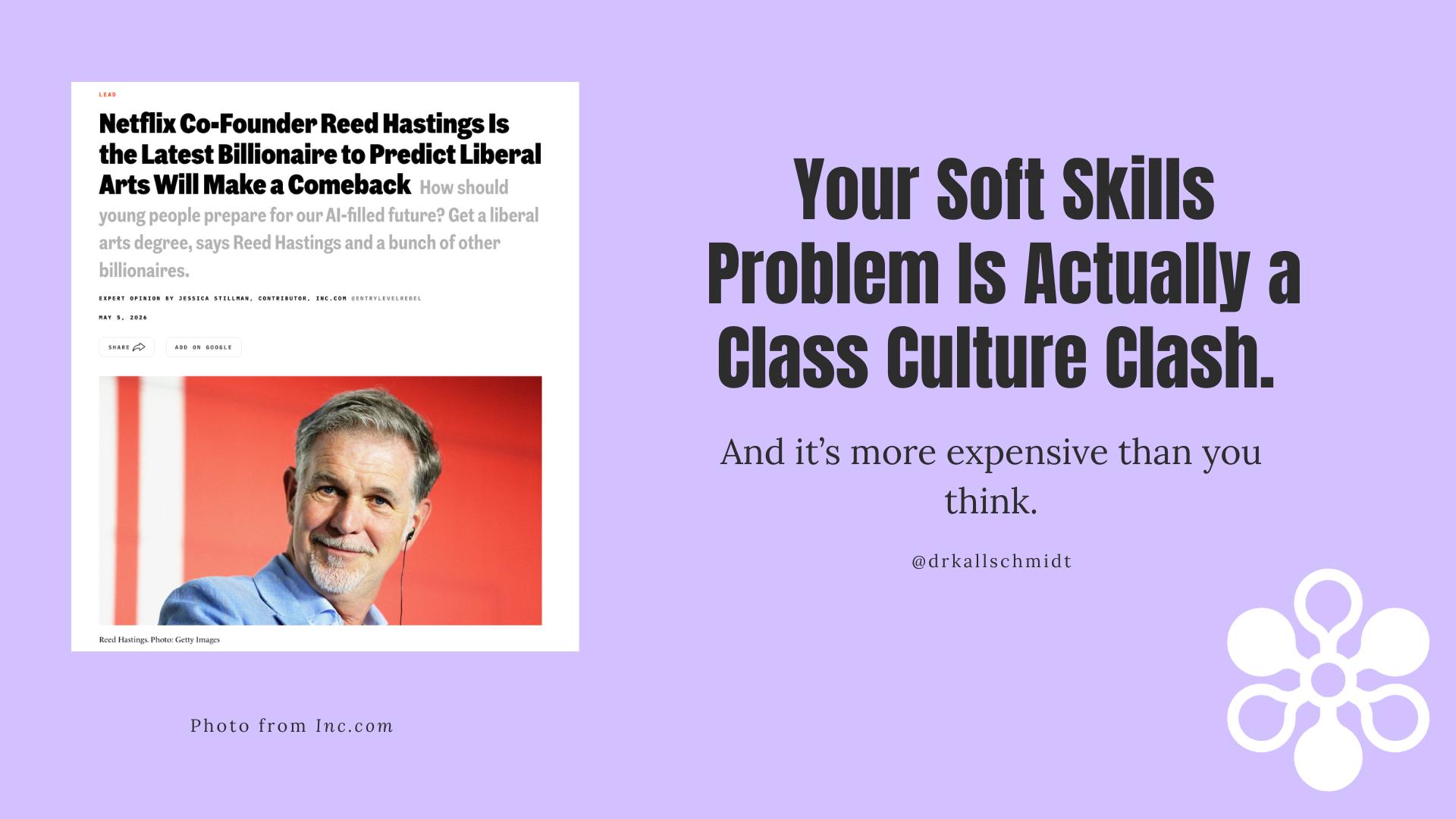
Billionaire Reed Hastings said he'd double down on emotional skills if he had a young child today.
Mark Cuban said in 2017 that liberal arts majors would be more in demand than programmers within a decade.
They're not wrong.
But they are describing a solution that only works if you're already them.
The Class Gap Nobody Names
For years, liberal arts degrees have received a lot of shit, especially from the working class in the U.S.
"Why'd you go into so much debt for a stupid liberal arts degree?"
"We shouldn't be handing out student loan money for degrees you can't get a job in, like in liberal arts."
"Get a STEM degree, those are the only ones that are useful."
But this is a class culture gap, and low-key a scam. The wealthy have always known that liberal arts degrees are useful and irreplaceable. But what they have not acknowledged, and what the working class are resentful of, is that they have a higher barrier to entry. Here is what that barrier actually looks like — and it is not just tuition.
In my social class mobility research, one pattern comes up over and over: people who "make it" by moving up in class frequently say things like, "I'm just one generation out from having an art major" or "because of my hard work, my kids can do something like get an arts degree." And this confuses people who are still in the working class. Why not just go to Walmart and get some watercolors, if you want your kids to paint? But it's not about the paint itself.
It is because having leisure time, mental energy in that leisure time, and the social connections to make a career in art actually pay off — those are markers of having already arrived. Liberal arts fields are hard to break into and make money in without knowing the right people. The degree is available. The network that makes it worth the wait is not.
And then there is the timeline. A STEM degree has a faster return on investment. You can be earning within a year or two. That is completely rational when you cannot afford not to be. A liberal arts degree requires years before the payoff shows up — years that working-class families often cannot wait through, without the safety net that makes waiting possible.
Class is not just income. It is time. It is who you can call. It is whether you can afford to wait.
A liberal arts degree teaches you how people work, and the outcomes of behaviors past (history, economics) and present (psychology, sociology). A good liberal arts education surfaces some of the art of navigating rooms of power: how power moves through an organization.
But here's what the billionaires aren't seeing, because their class position makes it invisible to them: there are still unwritten rules that are not taught in college. Technically, I have 3 liberal arts degrees — a B.A., M.S., and Ph.D. in psychology — and I still did a whole-ass dissertation on identifying the unwritten rules of work for the working class because I didn't know what the hell was going on. Class is more than income; it is a culture. And it's slithering through corporate.
My parents did go to college, but my mom stayed home and my dad worked at a pulp mill in rural America his entire career. I certainly had privileges not being a first-gen student. I'm not denying that. Yet, when I moved into spaces like Stanford, Yale, Big 4 firms — I didn't have anyone to call to explain what was going on. I was encountering things my dad did not experience at a pulp mill in rural Florida. And that's why I do the research I do; why I offer the services I do; and why I wrote my book — so that people can have access to this knowledge.
Billionaires are right that liberal arts are important. They're not seeing the real costs and extra privileges required to get the return on investment. A liberal arts degree still requires student loans. It still requires years before the return on investment shows up for people who do not already have a wealthy network. To get that network, it requires not just access to these spaces, but knowledge of the unwritten rules in them — like how to speak, how to disagree, how to self-promote (but not too much), how to ask (but carefully).
The unwritten rules aren't just taught in liberal arts classrooms. They're transmitted through networks, family dinner tables, internships at companies where someone's parent made a call, and four years of being embedded in an institution where everyone around you already knows how power works. A degree helps. It is not the whole solution.
History Repeating: STEM Then, Storytelling Now
We have been through this before. And the pattern is not subtle.
For a generation, working-class families were told: get a STEM degree. Learn to code. Those are the safe, serious, valuable skills. And they did. They went into debt for it. They built careers around it.
Then AI arrived. And overnight, "learn to code" became "oops, don't learn to code" — Reed Hastings's own words.
This is not a coincidence. This is a feature. The ruling class pushes certain technical skills because they benefit from the labor those skills produce. When technology makes that labor cheaper to automate, the push stops. The goalposts move. The people who built careers around those skills are left holding the cost.
And the goalpost has shifted again. Now, LinkedIn job postings mentioning storytelling more than doubled in 2025. Communications and writing roles at tech companies are posting salaries above $200,000. The market is already pricing these skills up.
If you cannot see the class dynamics underneath this, you will miss the pattern entirely. It is not just who does the work. It is who gets to name it, price it, and decide when it counts. The people making those decisions have always had liberal arts educations. They understand power, framing, and narrative. That is not accidental.
Liberal arts skills — communication, political navigation, reading people, understanding how institutions actually work — do not follow the automation pattern. They do not get made obsolete. They evolve with the technology, because they are about the humans operating alongside it. That is precisely why the wealthy have always quietly held onto them while steering everyone else toward something more practical.
And your employees are not going back to school. Not in this economy. Not without you funding it. And even then, that's a long time for a return on investment.
What This Means for Your Pipeline
Your organization has already done the recruiting. You have technically skilled, high-potential people in your pipeline — many of them first-generation professionals, working-class backgrounds, people who got every hard skill right and are now navigating an environment running on rules nobody wrote down.
They are not going to get liberal arts degrees. That is not a realistic organizational intervention. What is realistic? Making the rules legible.
The communication patterns that read as professional in your environment. How credit gets attributed and how to claim it. How to push back in ways that register as leadership rather than insubordination. How to build relationships with senior leaders without it feeling like — or being — performance. How to read what a meeting is actually about versus what the agenda says.
These are learnable. They are not personality traits. They are not inherent. They were taught — just not to everyone, and not in the same places.
This is what the AI moment is making more salient.
Technology is changing faster than any training program can keep up with. The organizations that survive this are not the ones with the most technically skilled employees — they are the ones whose employees can adapt. Who can read a shifting environment, absorb new information, navigate uncertainty, and keep moving without burning out or checking out.
That is not a technical skill. It is a cultural one.
And here is what the research shows: your first-generation and working-class employees may already be better at this than you realize — and far better than you are leveraging. UVA Darden research on "social class transitioners" — people who have moved between socioeconomic classes — found that they develop an exceptional cultural toolkit precisely because they have spent their lives adapting to environments with unfamiliar rules. They can connect across different groups, enable information flow, improve coordination, and reduce conflict. These are exactly the skills that make teams resilient when the environment keeps changing.
But the same research flags something critical: without support, this is exhausting. Socially isolating. The people doing this invisible adaptation work — decoding unwritten rules nobody wrote down, while also doing their actual jobs — are burning through cognitive and emotional resources every day. Some of them will quietly stop trying. Some will leave. And you will code it as a performance issue or a culture fit problem, because nobody named what was actually happening.
Your first-generation employees have the technical foundation and the adaptive capacity. What they are missing is the framework that makes that capacity sustainable — the explicit knowledge of the rules that everyone around them seems to already know.
That gap shows up as burnout. As "I quit." As a potential question at the promotion level. It is a curriculum gap. And it is costing you in attrition, stalled pipelines, and the quiet tax of your most adaptable people running out of runway before you ever see what they can do.
And while you are losing them, your competitors are not. The organizations that figure this out first are building the most resilient, most adaptable, most culturally fluent leadership pipelines in their industries — because they are developing the people everyone else is letting walk out the door. They are retaining institutional knowledge. They are promoting from within at higher rates. They are building teams that can absorb change without breaking. The class culture clash is not a soft problem. It is a compounding advantage for whoever solves it first — and a compounding liability for whoever doesn't.
What This Looks Like in the Clients I Work With
A senior professional promoted into high-visibility leadership meetings with no preparation for the political environment she'd just entered. She was spending every session managing anxiety instead of demonstrating the capability that got her there — because nobody had told her that being put on the spot in that room was her boss signaling trust, not threat. Once she understood the rule, she showed up differently. The anxiety didn't disappear. The paralysis did.
A high performer in a consulting environment whose ideas kept getting absorbed by others before she could finish articulating them. Not because the ideas weren't good — they were. She didn't yet know how to float them in the way that particular room required. That is a learnable skill. Once she learned it, her ideas started landing with her name attached.
A professional navigating a hostile management situation alone — documenting her own mistreatment line by line, for weeks, with no framework for what was happening or how to respond without making it worse. She had the intelligence. She was missing the read. Once she had it, she stopped being reactive and started being precise. The situation didn't resolve overnight. But she stopped losing ground.
These are not edge cases. These are the people already in your pipeline — stuck not because of performance, but because nobody made the rules legible.
The billionaires are right that these skills matter more than ever. They are not right that a liberal arts degree is the answer for a workforce that is already in your building.
That is where I come in.
What This Looks Like in Practice
I work with organizations through keynotes, workshop series, and coaching programs to make the unwritten rules explicit — the communication patterns, the relationship dynamics, the political navigation that your high-potential employees need and that no one has ever put in writing for them.
A keynote can open the conversation. A workshop series builds the skills of a team. Consulting goes deeper — using surveys and focus groups to surface the specific hidden norms shaping your culture, and building strategies to address them. For leaders navigating this individually, one-on-one coaching is available for both first-generation professionals and the leaders responsible for developing them.
The result is not a culture initiative. It is a performance outcome.
Ryan Waggoner at Strada Education Foundation put it this way after a recent session: "She has a clear knack for getting people comfortable talking about things that can sometimes be uncomfortable, like the role of social class in the workplace. Her actionable insights left us all feeling informed and empowered."
That is what happens when the rules get named.
If your organization has the people and not the pathway, this is the work.
A free 20-minute discovery call is the starting point: drkallschmidt.com/services
Dr. Anna Kallschmidt Organizational psychologist | Author, The Unwritten Rules of Work drkallschmidt.com
Wondering whether this gap is showing up in your own pipeline? Take the 2-minute quiz → to find out where.