
The Best Sales Strategies Break Unwritten Rules. So Do the Best Workplaces
July 8, 2026
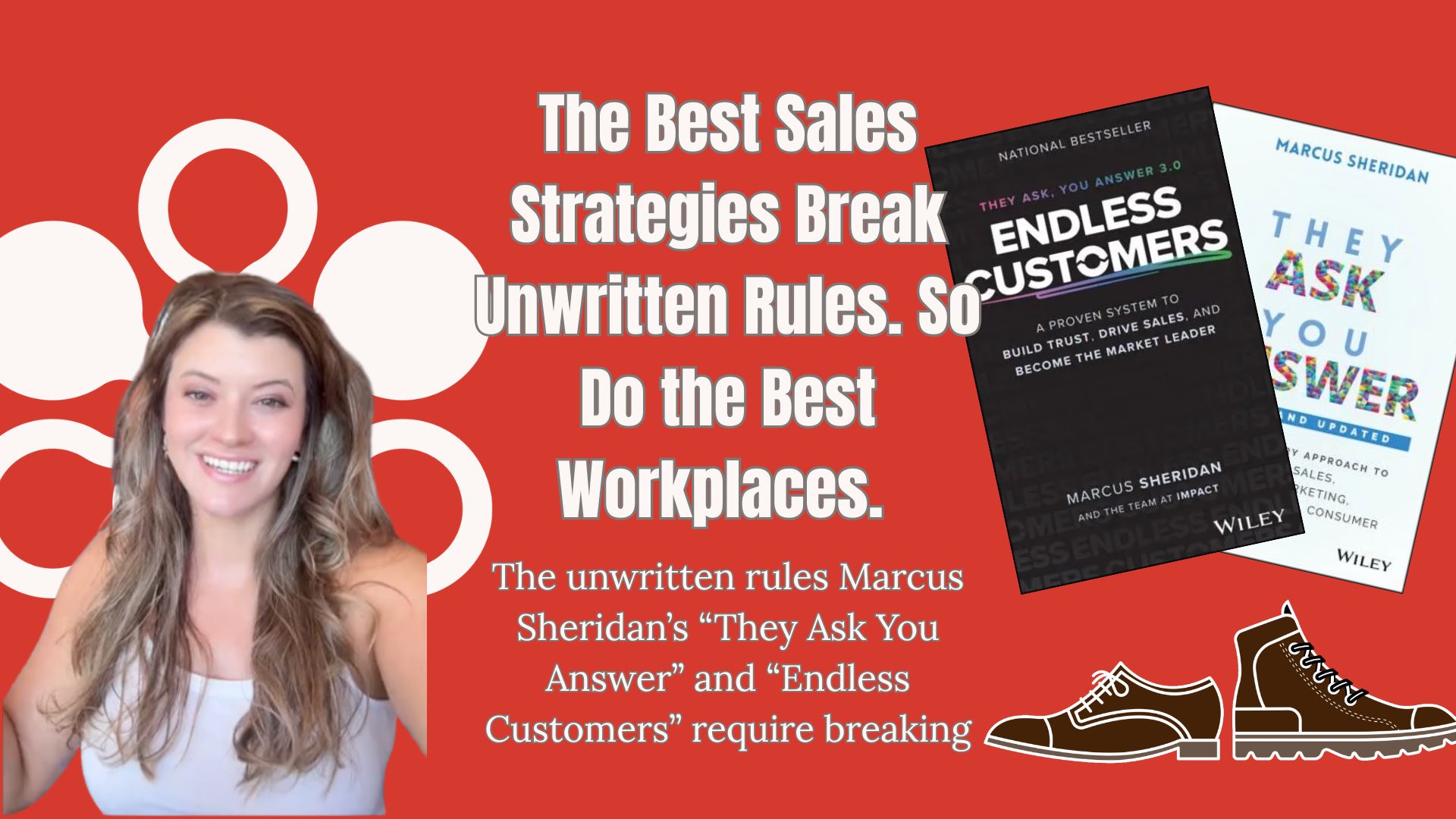
Marcus Sheridan built a swimming pool company into a $25 million business — during the 2008 financial crisis — by doing one thing that his entire industry considered career suicide: he answered the questions his competitors refused to.
How much does a pool cost? What are the pros and cons of fiberglass versus concrete? Which companies in our market have the best reviews — including ours? He published all of it. His competitors thought he was out of his mind. His customers thought he was the only one they could trust.
Sheridan has been sharing his sales tactics with companies around the world for nearly two decades now. And yet, in his most recent book, Endless Customers, he states that there are still few companies who truly replicate his practices. Why is that? Because many businesses are stuck in their own unwritten rules. They're not actually innovative. They're not helmed by leaders. They emphasize conformity and following, not "rocking the boat" (and what good is a boat that can't rock? Hello?), and waiting for someone else to take the risk before trying it.
I am a big fan of Sheridan's most recent book, as well as his original, They Ask You Answer. His strategies align closely with my business and personal values of transparency and integrity. Even though I am not new to Sheridan's work, I still opened and closed Endless Customers thinking, "Sheridan is doing exactly what I advise leaders to do with their employees. He's just doing it with sales." And even though his book isn't about the workforce, everything he has written, from his original book to now, provides examples of how breaking unwritten rules with your customers and your employees translates into dollars and happiness.
The Rule Nobody Wrote Down
Sheridan's two books are ostensibly about sales and marketing. But what he's actually describing, in example after example, is the competitive advantage of knowing which unwritten rules are holding your industry back, and having the courage to break them.
In his first book, he provides the example of CarMax in the 1990s. They didn't invent the used car. They asked what customers were actually afraid of. They heard:
-
Afraid of being pressured.
-
Afraid of buying a lemon.
-
Afraid of getting ripped off.
-
Afraid of buyer's remorse.
And then, most importantly, CarMax actually responded.
CarMax admitted the industry had a problem. Then they dismantled every fear on the list. No-haggle pricing. Flat-rate commissions so salespeople were incentivized to find the right car, not the most expensive one. A five-day money-back guarantee — one customer returned a Porsche because his dog couldn't get comfortable; CarMax mailed a full refund. A rigorous inspection process shown to customers in detail, not just claimed in fine print.
Every used car dealer knew these fears existed. Almost none addressed them — because addressing them felt like admitting the industry had a problem. When CarMax broke this unspoken rule, their entire industry thought they were insane. Initially, competitors laughed. Then spent two decades trying to copy it.
The unwritten rule of the used car industry was: never surface a fear you don't have to. CarMax decided that rule was costing them more than breaking it would.
Sheridan asks the question every business leader should be sitting with: What rules, written or unwritten, could you break to put yourself at an industry advantage?
Trust
Asking ourselves these questions in the current business climate can be terrifying. Because the questions we are also asking are:
"Why are people so cost-conscious nowadays?"
"Why are customers so picky?"
"Why is it so much harder to convert leads into sales right now?"
Because customers don't trust organizations anymore. Americans especially, are inundated with advertisement. There have been so many scandals, with so little corporate responsibility. People have been ripped off. And they're angry about it. Add a plague of declining customer service nationwide, and your customers are f*cking over it.
Sheridan's core message is your customer has to trust you. Gone are the days of customers being uninformed. The internet changed how consumers buy. At least 70% of the buying decision is made before customers ever come into contact with the sales team. Gone are the days where someone had to physically go to stores to compare pricing, and they may not find out if your competitor has better prices or products. People know now. The past two decades of Google searches and Amazon reviews have made this relatively easy.
But what have most companies done? The same old sales tactics pre-90s internet boom. Still "if we don't tell them the price, they won't find out." And Sheridan explains this infuriates customers because they know you know the price. They perceive that you just won't tell them because you want their money. And that pisses most people off.
What Sheridan doesn't say explicitly, but implies in context, is that to build these relationships with your customers, you must have these relationships with your employees. Yes. Even in the age of AI.
What he shows through examples — and what I want to say plainly, as an industrial-organizational psychologist — is that the same dynamic runs inside your organization. Your employees are also making trust calculations. They're also deciding what to share, what to surface, what to say in the room versus what to keep to themselves. And the unwritten rules of your workplace are what determine the outcome of that calculation, every single day.
Sheridan gets this. In They Ask You Answer, fixing the sales process freed his employees — better leads, better work-life balance, no burning people out to chase customers who were never going to buy. In Endless Customers, he talks about training his workforce to use AI rather than replacing them, and building a culture where smart failure is safe and people can say that's not working without risking their jobs. He's operating from the same values in both directions — toward customers and toward his team.
It's just a different area of expertise. He's a sales strategist. I'm an organizational scientist. But the two bodies of knowledge arrive at the same place: how you treat people is the business. It always has been.
And we can actually measure it. Gallup's research across thousands of business units found that highly engaged employees produce 10% higher customer ratings, 18% higher sales productivity, and 23% higher profitability. Bain & Company found that companies with highly engaged employees achieve 2.5 times more revenue growth. This is not a new phenomenon. In a 1998 study of Sears — published in Harvard Business Review — researchers tracked the causal chain directly: every 5-point increase in employee engagement produced a 1.3% increase in customer satisfaction, which translated to a 0.5% revenue increase per year. At Sears's scale, that was $250 million annually.
This isn't "soft" or "DEI" or "extras." This is the business case. You cannot build the kind of customer trust Sheridan describes without first building the kind of internal culture where employees trust you. Because your employees are who represent you to your customers, and who influence whether leads become sales.
The Unwritten Rules That Break Implementation
And leads are less likely to become sales if these unwritten rules are blocking your culture. Are these unwritten rules in your organization?
Sheridan's system requires two things most companies don't have. First, a Revenue Team — his term for bringing marketing, sales, and leadership together around one mission: making your brand the most known and trusted in your market. Not separate departments occasionally sharing a spreadsheet. One team, sharing ownership of the entire buyer's journey. Second, an Alignment Day — a focused session where every person who touches a customer gets in the same room, gets on the same page, and leaves knowing exactly what their role is in making the strategy work. Sheridan is blunt: "When your entire customer-facing organization isn't involved, gaps form, the strategy falls apart, and results suffer."
Toxic Independence — The unwritten rule of toxic levels of independence encourages employees to only look out for themselves. To self-promote. And to even sabotage if it means making themselves look better. In my book, I mention how Microsoft had this issue in the 2010s. They implemented a stack ranking performance system, where bottom-ranked people, even if they were not low performers, were forced to leave every year. This incentivized people to sabotage any idea that was not their own, out of fear of losing their livelihoods. Satya Nadella worked diligently to move them toward "one Microsoft." Their employees (and their stocks) got back on their feet.
Sheridan is explicit that his model only works if the whole organization is aligned. Sales and marketing together — no silos. Everyone building in the same direction. He's watched it fail when companies skip that part. It takes a lot of work to work together, especially since most corporate systems are set up to reward individualism over interdependence. When collaboration has historically cost people credit instead of earning it, the unwritten rule becomes: protect your lane. That's the opposite of the Revenue Team Sheridan builds, where sales, marketing, and leadership are unified around one mission.
Compliance — This is the expectation that you don't challenge people in power, even when they appear to be asking. You can't get honest feedback in a sales retrospective, surface real buyer fears in your content strategy, or build a culture where smart failure is safe, if people have learned that disagreement carries a cost. This is the rule that most directly kills the kind of bold, disruptive thinking Sheridan describes.
And he names what resistance sounds like: "This is how we've always done it." "What if this fails and we look bad?" "This is how our industry works." Sheridan calls these fear — fear of failure, fear of rocking a boat that struggles to float. He's right. What he doesn't name is the structural reason that fear exists: compliance isn't just individual timidity, it's a rule the culture enforces. The tone set at the top doesn't automatically translate down. The rule intercepts it.
Indirect communication — if the norm is to talk around things rather than say them directly, you won't get honest buyer intelligence surfacing in your content strategy. You'll get what people think they're supposed to say.
Assertive but not too aggressive — Alignment Day only works if everyone actually speaks. But if certain people have learned they'll be read as difficult for speaking directly — while others get praised for the exact same behavior — some voices go quiet before the session even starts. And you won't know what you're missing, because the rule is invisible.
There's also an energy cost that doesn't show up in any framework but is very real. When employees don't know what the actual rules are — when stated values and real expectations don't match — they spend enormous cognitive energy just decoding the environment. That energy is not going into the bold ideas that make you the most trusted brand in your market. It's going into self-protection.
Sheridan says you need everyone aligned and building together. He's right. Unwritten rules are often exactly what's preventing it — invisibly, expensively, before anyone names the problem.
What Do You Do?
You can't break the rules that are costing you until you know what they are.
I offer a free unwritten rules audit — a conversation to identify which rules are operating in your organization and where they're creating the most friction, silence, or risk.
For leadership teams ready to go further, I run a workshop that teaches leaders to identify the unwritten rules themselves, understand why people can't navigate them, and start problem-solving immediately — not after a six-month culture initiative.
What It Looks Like When You Name Them
The audit and workshop I run do one thing: make the invisible visible. We identify which unwritten rules are operating in your organization, why people can't navigate them, and what to do about it — not after a six-month culture initiative, but immediately.
Here's what leaders say after doing this work:
"She has a clear knack for getting people comfortable talking about things that can sometimes be uncomfortable, like the role of social class in the workplace. Her actionable insights left us all feeling informed and empowered to make our organisation a better place for people of all backgrounds." — Ryan Waggoner, Strada Education Foundation
One attendee put it simply: "A lot of subtle challenges make sense after this."
If that's the feeling you have, let's set up a 20-minute call. Sheridan talks about how most business owners prefer "ostrich marketing," which is the analogy of an ostrich sticking its head in the sand. I think I say three times in my book, "Ignoring the unwritten rules of work does not spare you from the consequences." It's time to do something about this feeling, for the sake of your sanity and your business.
Not sure which unwritten rules are actually running in your organization? Take the 2-minute quiz → to find out where the friction is.