
“I don’t think I’ve ever even heard of a single person who thinks all leaders are evil and pursuing career advancement makes a person bad. Nothing even remotely like that. In any industry. Ever. [Author’s note: I never said that, but clearly this person is triggered.] I’m a bit concerned for you if you have enough people in your life who actively avoid career advancement and leadership for you to make such generalizations that everyone in society also has these views on leadership…. Are you only friends with people who insist on making only minimum wage?”
I received this comment on a video clip about my recent article, “Is it possible to have an ethical business under capitalism?” This comment was a stark contrast to a clip from the same video on my TikTok:
“Did you see the Epstein files? They literally r*ape & eat Babies. What is the point anymore?”
And this, my friends, shows opposite ends of the spectrum right now on our perceptions of not just leadership, but the world, because of how it has been led. From “You’re poor if you don’t ‘get it'” to “I don’t even know what to do with these levels of corruption.”
The Epstein Files: What 3 Million Pages Revealed About Our Leaders
The Epstein files dropped this month. 3 million pages. Billionaires. World leaders. Business executives. University presidents. Nobel Prize winners.
Pedophiles. Possibly murderers. Some allegations even include cannibalism.
What many of them had:
- Power and wealth
- Access to elite circles
- Charisma and charm
- Understanding of how to manipulate human behavior
- Ability to exploit power dynamics
What they didn’t have: empathy.
Not the inability to read people – many had that skill. They understood power, social hierarchies, how to identify and exploit vulnerability. This isn’t my assumption. They know this too; several of the men in these files have been blatantly telling us they hate empathy. And emotional intelligence is so undervalued that we have argued over whether this is a red flag (or a sin) or not.

Emotional Intelligence and Social Intelligence.
Let me be precise about what we’re talking about here, because this distinction matters:
Social Intelligence = Understanding social dynamics and knowing how to navigate them
- Social awareness: Reading social cues, understanding hierarchies, recognizing power dynamics
- Behavioral regulation: Controlling your own behavior to achieve social goals
- Strategic social navigation: Knowing what to do in social situations to get what you want
Social intelligence PLUS the capacity to care
- Everything in social intelligence, PLUS:
- Empathy: Actually caring about how your actions affect others
- Genuine concern: Seeing others as full human beings, not objects
- Moral constraint: Letting empathy guide your behavior, not just strategy
The critical distinction: Empathy is what separates emotional intelligence from social intelligence.
Someone can have high social intelligence – reading people accurately, navigating hierarchies skillfully, controlling their behavior strategically – without having empathy. That’s the Epstein gang.
The Epstein gang had social intelligence. They lacked emotional intelligence – specifically, they lacked empathy.
They could:
- Read social cues brilliantly (social intelligence)
- Understand power dynamics (social intelligence)
- Control their behavior to achieve goals (social intelligence)
- Identify and exploit vulnerability (social intelligence used as weapon)
What they lacked: Empathy.
They couldn’t – or wouldn’t – care about the impact of their actions on others. They saw people, especially children, as objects to use rather than humans to protect.
Without empathy, social intelligence becomes a tool for manipulation and harm.
How This Connects to Your Workplace
Here’s what no one’s talking about: The business people on this list almost certainly hired individuals with genuine emotional intelligence.
People with real empathy. People who could:
- Read social dynamics AND care about people (emotional intelligence)
- Manage complex situations AND build psychological safety (requires empathy)
- Navigate office politics AND maintain integrity (emotional intelligence)
- Help everyone regulate emotions (requires caring, not just understanding)
And these hires with genuine emotional intelligence – the ones with empathy – were likely exploited for their skills while leaders without empathy climbed the ladder.
Because in most workplaces:
- Social intelligence without empathy gets rewarded (looks like “leadership”)
- Social intelligence WITH empathy gets exploited (becomes unpaid emotional labor)
The person who can read the room and manipulate it? Promoted.
The person who can read the room and cares about making it better? Stuck doing everyone’s emotional work.
This isn’t just about one scandal. It’s about a pattern playing out in workplaces everywhere, just on different scales.
You’re the one who defuses conflicts. You read the room before anyone else does. You help your boss manage their stress, smooth over team tensions, and create psychological safety.
So why are you still in the same role while people with social intelligence but no empathy – who use their skills to climb over others – get promoted?
Why This Matters to Your Career (Even If You’re Not on Anyone’s Files)
I research the unwritten rules of work for first-generation professionals and neurodivergent individuals. I’ve conducted hundreds of consultations.
And here’s what I keep seeing: The same pattern that puts predators in power also keeps empathetic, high-EQ people stuck.
We select for wealthy white usually men (the Ghislaine Maxwell’s are there, I’ve written and recorded on this extensively) who can:
- Read emotions well enough to manipulate them
- Charm their way past accountability
- Build empires without caring who they crush
- Use social knowledge as a weapon
And we call that “leadership.”
Meanwhile, people with genuine emotional intelligence – the kind that includes actual empathy – get exploited:
- Your boss relies on you to manage conflicts they created
- Leadership takes credit for team culture YOU built (and then sabotages it)
- You’re expected to absorb everyone’s stress and dysregulation
- Your empathy gets weaponized as “you’re such a team player” while you do unpaid emotional labor
- You advocate for yourself and get labeled “not a culture fit”
The Epstein files are the extreme end of what happens when we select for social skills without empathy. But the pattern exists everywhere.
Your workplace might have predators (honestly, it’s quite likely, because predatory behavior is what patriarchy incentivizes – exploiting the vulnerable). You might not know. The Epstein files are at least a decade old – the modern Epstein hasn’t been caught yet. The only one on the list who is in jail is the woman (and she should be, but she should not be alone in there…).
But even if your workplace doesn’t have predators, it likely has leaders who:
- Understand emotions well enough to exploit them
- Can read the room but don’t care about psychological safety
- Value “being strategic” over caring about people
- Mistake confidence for competence
- Promote charisma over character
And here’s what matters: The same hiring and promotion practices that keep empathetic high-EQ people stuck are the same practices that allow predators to thrive unchecked.
The Real Problem: When We Hire, Promote, and Lead Using Unwritten Rules Instead of Skills
Here’s what I’ve learned from researching the unwritten rules of work for my entire career:
When we make decisions based on unwritten rules instead of actual job performance, we don’t just fail to promote good people. We actively select for and protect predators.
Let me be clear about what I mean by “unwritten rules”:
Unwritten rules are NOT the same as soft skills or culture.
- Soft skills = Communication, collaboration, conflict resolution, emotional intelligence
- Culture = Shared values, norms, and practices that help people work together effectively
These are important. These should be taught, named, and accessible to everyone.
Unwritten rules = Cultural knowledge that is deliberately withheld, centered on one dominant group, and used to exclude others.
Examples of unwritten rules:
- “Schmoozing” (but only certain types of relationship-building count)
- “Executive presence” (but only if you look/sound like current leadership)
- “Culture fit” (but the culture is defined by whoever’s already there)
- “Strategic thinking” (but only certain communication styles register as “strategic”)
- “Leadership potential” (but only certain identities are seen as having it)
These aren’t about skills. These are gatekeeping mechanisms disguised as competence. The rules are unwritten so that they are assumed to be normal.
For predators to convince us that their behavior is acceptable, they must convince us that this is just behavior that anyone would do in their position. That it’s what “good leadership” and “smart business” look like. That greed is normal. They shouldn’t have to tell us this, because it’s just inherent. That no emotional intelligence, no empathy, is not just okay, but normal.
And here’s the devastating cost: When we reward people for knowing unwritten rules rather than for doing the work well, we create environments where predators thrive.
How Unwritten Rules Enable Predators: The Mechanism
These unwritten rules don’t appear from nowhere. They’re shaped by larger systems of dominance: classism, white supremacy, patriarchy, and ableism.
Step 1: We center one group’s norms and call them “universal standards”
Classism: Upper-middle-class cultural knowledge becomes the only legitimate “professionalism”
- Knowing wine pairings, golf etiquette, private school references
- Speaking in measured tones without “too much” emotion
- Having the right degrees from the right schools
- Working-class directness = “unprofessional”
- Working-class solidarity = “not ambitious enough”
White supremacy: European-American communication patterns become the only valid “executive presence”
- Indirect conflict avoidance, emotional restraint, extreme individualism
- Specific vocal tones, cadences, body language
- Cultural references to white-dominated media and history
- Black assertiveness = “aggressive” or “angry”
- Indigenous consensus-building = “indecisive”
- Asian collectivism = “not leadership material”
Patriarchy: Masculine leadership models become the only acceptable “strategic thinking”
- Dominance over collaboration
- Emotional suppression as “rational”
- Competition over cooperation
- Decisiveness over consultation
- Dominance over the vulnerable as “strength” – the same logic that enables abuse of power
- Women’s relational leadership = “too soft” or “emotional”
- Collaborative approaches = “lacks vision” or “can’t make tough calls”
When dominance becomes the core value of leadership, it creates a gateway for predatory behavior. Those who most easily exploit power imbalances – including over children, the most vulnerable – are those who’ve been rewarded for “dominance” their entire careers.
Ableism: Neurotypical social scripts become the only “good culture fit”
- Reading unspoken social cues and subtext
- Navigating ambiguous social situations
- Performing neurotypical emotional expression
- Masking discomfort or distress
- Autistic directness = “lacking social skills”
- ADHD adaptability = “unfocused” or “scattered”
- Anxiety about mistakes = “not confident enough”
Important distinction: There’s a difference between unspoken social cues (culturally-specific, often exclusionary) and social intelligence (understanding and caring about impact on others). Many neurodivergent people have deep social intelligence through different pathways – they care deeply about others and understand social dynamics, they just process and communicate differently. Requiring neurotypical social performance isn’t about competence – it’s about gatekeeping.
These aren’t neutral competencies. These are gatekeeping mechanisms disguised as standards.
Step 2: We treat violation of these norms as incompetence
Not “different communication style” – deficient.
Not “different leadership approach” – inadequate.
Not “different social patterns” – unprofessional.
Anyone who doesn’t naturally perform these culturally-specific scripts gets labeled:
- “Not ready for leadership”
- “Needs development”
- “Lacking executive presence”
- “Not the right culture fit”
- “Would struggle at the next level”
Step 3: We cite “survival of the fittest” while ignoring Darwin’s actual findings
Darwin wrote about cooperation and empathy as evolutionary advantages. Species that work together, care for each other, build mutual support – they’re the ones that survive and thrive.
But we’ve twisted “survival of the fittest” to mean: exploit the vulnerable, dominate others, take what you can.
We call exploitation “nature” to avoid calling it what it is: a choice.
Step 4: We make these culturally-specific rules unwritten
- Don’t teach them explicitly (so only people who grew up with them know)
- Claim they’re “just common sense” (so violations seem like personal failure)
- Punish people for not knowing them (so the gatekeeping seems earned)
- Reward people who already know them (so privilege looks like merit)
Step 5: We select for people who can perform this specific cultural script
Who already knows how to schmooze? People from upper-middle-class families who watched their parents do it.
Who already has “executive presence”? People who sound and look like current executives.
Who already “fits the culture”? People who share the dominant demographics.
Who can navigate unspoken rules? People from the dominant culture who absorbed them growing up.
Step 6: We’ve now created an exclusive environment
- Blatantly called “exclusive” like it’s a badge of honor
- Homogeneous in demographics, culture, and thought
- Hostile to outsiders who “don’t get it”
- Protective of insiders who “understand how things work”
This is gatekeeping by design, not accident.
And here’s what happens in these exclusive environments: Abuse becomes inevitable.
Why Exclusive Environments Are Dangerous
When you create an environment where:
- Only one type of person gets in
- Success depends on knowing secret rules
- Outsiders are automatically suspect
- Insiders protect each other
- Questioning the culture means you “don’t fit”
- Speaking up gets you labeled “not a team player”
You have created the perfect conditions for predatory behavior.
Because now:
- Predators can identify vulnerable targets (people who don’t know the unwritten rules, who are trying to “fit in”)
- Predators can exploit power imbalances (if you don’t fit, you have less standing to complain)
- Predators get protected by the group (maintaining the exclusive culture matters more than individual harm)
- Victims who speak up get blamed (clearly they “didn’t understand the culture” or “weren’t the right fit”)
The Epstein network operated in exactly these kinds of exclusive environments:
- Elite universities (unwritten rules about who belongs)
- Billionaire social circles (unwritten rules about loyalty and discretion)
- Scientific and academic prestige (unwritten rules about who gets believed)
- Political power structures (unwritten rules about access and influence)
These weren’t just wealthy environments. They were EXCLUSIVE environments. Designed to keep most people out. Designed to protect insiders.
What Elite, White, Male, Neurotypical Environments Have Shown Us
Let me be direct: These environments have shown us what they are.
Not all elite environments. Not all white-dominated spaces. Not all male-led organizations. Not all neurotypical cultures.
But when you combine ALL of those things – when you create environments that are:
- Elite (economic gatekeeping)
- White (racial homogeneity)
- Male (gender exclusion)
- Neurotypical (neurodivergent people pushed out)
- Operating on unwritten rules (cultural gatekeeping)
You get the Epstein list. You get Wall Street’s sexual harassment culture. You get tech’s “bro culture.” You get Hollywood’s systematic abuse. You get university departments protecting predatory professors. You get churches covering up abuse. You get corporations where everyone “knew” but nobody could speak up.
Because in these environments:
- Success depends on fitting in, not on competence
- Fitting in means knowing unwritten rules
- Knowing unwritten rules means you’re “one of us”
- Being “one of us” means the group protects you
- And if you’re not “one of us”? You’re the problem, not the predator
This isn’t about demonizing any particular identity. I’m white. Many of my clients are men. Plenty of elite institutions do good work.
This is about naming what happens when we create exclusive environments and call them “high-performing.”
The Alternative: Explicit Rules, Accessible Culture, Actual Skills
Here’s what changes when we do it differently:
Make rules explicit:
- Teach communication norms directly
- Name what “professionalism” means in your context
- Explain what “leadership” looks like with clear behaviors
- Make expectations transparent
Assess actual skills:
- Can they do the work?
- Do they achieve results?
- Do they collaborate effectively?
- Do they solve problems?
- Do they grow and adapt?
Build accessible culture:
- Multiple ways to belong
- Multiple communication styles valued
- Multiple paths to leadership
- Genuine inclusion, not just demographic diversity
When you do this:
- High-EQ people with empathy can thrive (their skills are recognized)
- People from different backgrounds can succeed (they’re not penalized for not knowing secret rules)
- The assumption of “normal” breaks down. When more than one type of person is allowed to succeed, when rules are actually questioned rather than docilely accepted, there’s no single standard to submit to. Abuse can’t be justified as “just how we do things” when there isn’t a homogeneous group enforcing what “we” means.
- Predators can’t hide behind “culture” (their lack of actual competence becomes visible)
- Speaking up becomes safer (you’re not challenging “how we do things,” you’re holding people to explicit standards)
The Epstein list exists because we’ve tolerated exclusive environments that operate on unwritten rules for too long.
Every person on that list thrived in environments where:
- Success meant knowing who to know
- Advancement meant fitting in
- Power meant protecting insiders
- And abuse could be dismissed as “not understanding the culture”
We can’t prevent all abuse. Evil exists. But we can stop creating the conditions where it thrives unchecked.
What actually changes this:
Stop hiring for “culture fit.” Hire for skills and values.
Stop promoting people who “just get it.” Promote people who do the work well.
Stop calling exclusivity “excellence.” Call it what it is: gatekeeping.
Stop protecting predators because they know the unwritten rules.
Start making the rules explicit. Start valuing actual competence. Start building cultures where different types of people can thrive.
Because the environments that exclude diverse people are the same environments where predators operate freely.
The Epstein list proved it. Your toxic workplace proves it. It’s time to change the rules.
What Emotional Intelligence Actually Is (And Why Empathy Is Non-Negotiable)
Real emotional intelligence is not:
- Being nice
- Managing other people’s emotions for them
- Being agreeable
- Never having boundaries
- “Taking one for the team”
- Being the office therapist
Real emotional intelligence is a competence. It has five components:
- Self-awareness: Understanding your own emotional patterns and triggers
- Self-regulation: Managing your responses appropriately (not suppressing them)
- Motivation: Having internal drive toward goals
- Social awareness: Reading social dynamics accurately
- Empathy: Understanding others’ perspectives and emotional states – AND caring about their wellbeing
That last one – empathy – is what separates genuine emotional intelligence from sophisticated manipulation.
You can have the first four components and still be deeply harmful. You can:
- Know exactly how you’re coming across (self-awareness)
- Control your reactions strategically (self-regulation)
- Stay laser-focused on your goals (motivation)
- Read every social cue in the room (social awareness)
And use all of that to exploit people.
Darwin’s research emphasized cooperation and empathy as evolutionary advantages. The species that survive? The ones that develop mutual support systems. The ones that can work together, care for each other, build communities – they’re the ones who thrive long-term.
But we’ve built workplace cultures that reward the first four components of EQ while actively punishing empathy.
We promote people who can read the room well enough to play politics, but who view empathy as weakness.
We elevate leaders who understand emotions intellectually, but don’t actually care about the humans experiencing them.
Note: Social awareness doesn’t always mean “reading the room” in the neurotypical sense. Neurodivergent folks often have deep emotional intelligence through different pathways – pattern recognition, direct communication, systematic analysis of behavior. The key is whether you understand AND care about impact on others, not whether you pick up on unspoken social cues the “typical” way.
The Dark Triad: When Emotional Intelligence Becomes a Weapon
Daniel Goleman, in his book Social Intelligence (a follow-up to his famous book Emotional Intelligence), identified what he calls “The Dark Triad”: narcissists, Machiavellians, and psychopaths.
All three types can have high social awareness – they can read emotions, understand social dynamics, manipulate situations masterfully. What they lack is empathy. [Removed “Here’s what that looks like in each type” detail – keeping it brief]**
Narcissists: Crave admiration, selective empathy, hypersensitive to criticism, surround themselves with sycophants
Machiavellians: Smooth upward/cruel downward, see people as tools, tunnel-vision empathy only when it serves them
Psychopaths: No fear, no remorse, literally numb to human suffering, can learn to “push all the right buttons” intellectually
But here’s what Goleman warns about that’s even more relevant to your workplace: Organizational narcissism.
Collective Narcissism: When Entire Companies Get Sick
When enough people in an organization share a narcissistic outlook, Goleman explains in Social Intelligence, the entire company becomes narcissistic. The pathology becomes standard operating procedure.
What organizational narcissism looks like:
- Grandiosity becomes the norm (“We’re changing the world!”)
- Healthy dissent dies out
- Leaders expect to hear only messages confirming their greatness
- Bearers of bad news get punished or fired
- Truth gets suppressed to maintain the shared illusion
- Everyone colludes to maintain collective self-adulation
- Paranoia and suppression thrive
- Work devolves to a charade
Sound familiar?
This is how it connects to the unwritten rules I research:
The Rule of Toxic Individualism:
- In narcissistic organizations, it’s every person for themselves
- But you have to PRETEND you’re a team player
- Your success comes at others’ expense (that’s “just business”)
- Meanwhile, high-EQ people who actually value collaboration get exploited
The Rule of Compliance:
- Narcissistic leaders demand agreement, not feedback
- “Organizational fit” means “won’t challenge the illusion”
- Speaking truth becomes “not being a team player”
- High-EQ people see the problems but learn to stay quiet or get pushed out
The Rule of Schmoozing:
- It’s not about building genuine relationships
- It’s about feeding the narcissist’s ego
- Playing to superiors’ vanity becomes the path to advancement
- High-EQ people who want authentic connection get labeled “not strategic”
The Rule of Additional Labor:
- Narcissistic organizations demand emotional labor to maintain the illusion
- You’re expected to perform enthusiasm, loyalty, belief in the “mission”
- High-EQ people do the work of making everyone feel good about the dysfunction
- Meanwhile, the narcissists take credit and get promoted
Here’s the tragedy Goleman identifies in Social Intelligence:
In narcissistic organizations, employees who gain ego-inflation from belonging will willingly bend the truth. They suppress information that doesn’t fit the grandiose image. Not cynically – they genuinely believe in the shared delusion.
When this happens, authentic connection dies. Employees tacitly collude to maintain shared illusions.
Everyone knows something’s wrong. But saying so threatens the group’s narcissistic high with a deflating feeling of failure or shame. And in a narcissistic organization, the knee-jerk response to that threat is rage.
So people who challenge the self-flattery – even with crucial information – get demoted, upbraided, or fired.
The narcissistic organization becomes a moral universe of its own. A world where its goals and means aren’t questioned. Where doing whatever we need to get whatever we want seems perfectly fine. Where the rules don’t apply to us, just to others.
You can probably think of some example sof your own, but in each chapter of my book I address an unwritten rule of work, and in each chapter of my book I give real-life examples of real-life organizations that lost major money, power, reputation, and even lives because of this.
Why High-EQ People Can’t Survive in Narcissistic Organizations
If you have genuine emotional intelligence – the kind with empathy at its core – you cannot thrive in a narcissistic organization. Here’s why:
You see the truth. Narcissistic organizations require you to suppress truth to maintain the illusion. But your emotional intelligence makes you aware of what’s actually happening. You can’t unsee it.
You value authentic connection. Narcissistic organizations require performative relationships. Schmoozing. Playing to egos. High-EQ people with empathy crave genuine human connection. The charade is exhausting.
You care about impact. Narcissistic organizations require you to ignore how your actions affect others. But empathy means you FEEL the impact. You can’t turn that off without destroying what makes you effective.
You need feedback. Narcissistic organizations punish truth-telling. But high-EQ people need reality checks to grow. You get better through honest feedback. In a narcissistic organization, that’s seen as disloyalty.
This is why you’re stuck while people without empathy get promoted.
They can play the game. They ENJOY the game. Feeding the narcissist’s ego doesn’t cost them anything – they don’t care about authentic connection anyway. Suppressing truth doesn’t bother them – they were never attached to it. Ignoring impact on others? That’s just efficiency.
You’re not failing to advance because you lack skill. You’re failing to advance because you refuse to participate in collective narcissism.
And that, right there, is why the Epstein list exists.
But this raises the critical question: If people with genuine emotional intelligence can’t survive in narcissistic organizations, how do we ever get good leaders? Are we doomed to live in a world of corrupt predators?
The Path Forward: How Good People Can Change the System
This is the work. This is why I do what I do.
Option 1: Leave narcissistic organizations (Protect yourself)
If you’re in an organization where:
- Truth gets punished
- Empathy gets exploited
- Narcissists protect each other
- Your values are incompatible with advancement
Get out. Your mental health, your integrity, and your safety matter more than trying to change an organization that doesn’t want to change.
Use your high EQ to recognize these environments early. Document what you’re seeing. Build your exit strategy. Protect your energy.
This isn’t giving up. This is strategic self-preservation.
Option 2: Build power strategically (Change from within)
Some organizations can be changed. The ones where:
- Leadership is merely clueless, not malicious
- Some people in power care about this
- You have allies
- There’s at least some openness to feedback
If you choose to stay and build power:
- Learn to navigate the unwritten rules without internalizing them
- Build coalitions with other high-EQ people
- Document everything
- Get promoted (yes, really – you need positional power to change systems)
- Once you have power, use it to change hiring, promotion, and accountability practices
- Make the rules explicit
- Protect people coming up behind you
This is my coaching philosophy: Help people survive long enough to get into positions where they can change things. If this is what you need, book 20 minutes with me to see if we’re a fit.
You can’t change systems you can’t navigate. And you can’t navigate systems you don’t understand. But once you understand them and get power? Change them.
Option 3: Build alternative structures (Create something new)
Start companies. Build organizations. Create communities.
From the beginning:
- Make expectations explicit
- Hire for skills and values, not “culture fit”
- Build multiple paths to success
- Value different communication styles
- Create actual psychological safety
- Hold everyone to the same standards
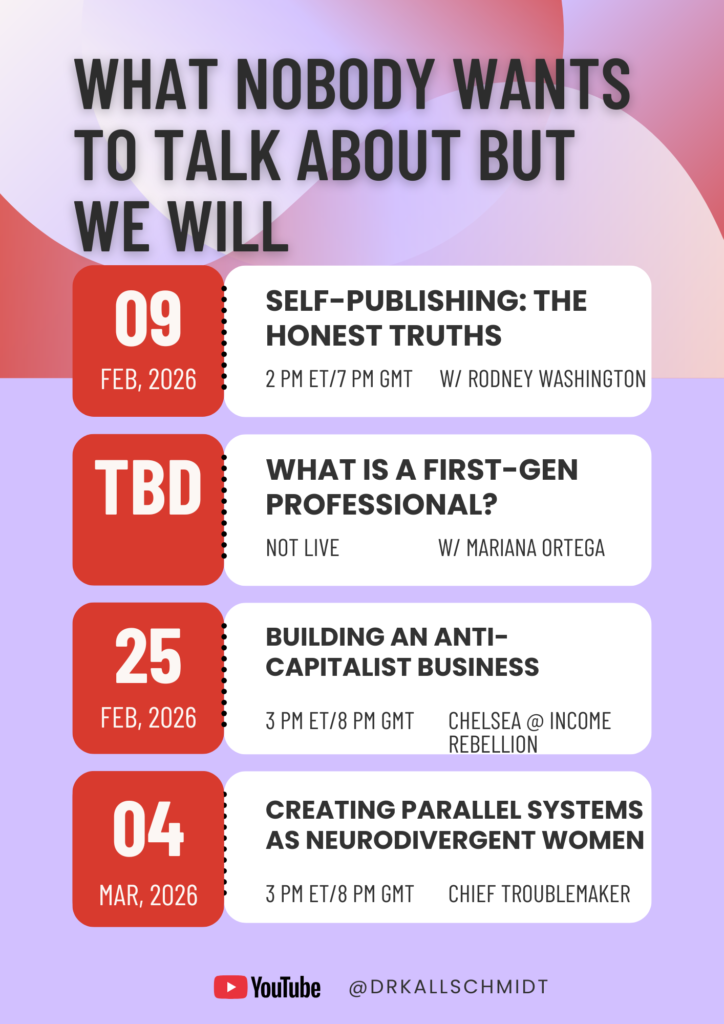
This is the long game. Building workplaces where empathy is valued, not exploited. Check out some of my upcoming free events where I’ll be talking with business leaders committing to doing this:
How We Get Good Leaders: The Systemic Answer
Individual choices matter. AND we need systemic change.
We need to stop selecting for people who already know unwritten rules and start assessing actual competence.
Because right now, our hiring and promotion practices are shaped by classism, white supremacy, patriarchy, and ableism – the systems I detailed earlier.
The result? We select for people who can perform a specific cultural script. And guess who’s best at performing it?
- People who grew up with it (class privilege)
- People who don’t threaten the status quo (demographic homogeneity)
- People who can schmooze with current leaders (social capital)
- People who aren’t bothered by exploitation (lack of empathy)
This is how we end up with the Epstein list. This is how we end up with toxic leaders. This is how narcissists rise while empathetic people get stuck.
What Actually Changes This:
At the individual level:
- Recognize narcissistic organizations early
- Protect yourself
- Build power strategically when possible
- Support other high-EQ people
At the organizational level:
- Make rules explicit
- Assess skills, not “fit”
- Build accessible culture
- Hold leaders accountable for outcomes AND behavior
- Value empathy as strategic competence
At the systemic level:
- Name how classism, white supremacy, patriarchy, and ableism shape our definition of “good leadership”
- Reject the lie that exploitation is “just nature”
- Remember Darwin’s actual finding: cooperation and empathy drive evolutionary success
- Build structures where diverse people can thrive
Red Flags & Green Flags: Recognizing Who Values Your EQ
Here’s what I need you to understand: Want-to-be tyrants without a following are just angry people in YouTube comments. They’re not CEOs. They’re not world leaders. They’re not people with actual power.
The Epstein list didn’t happen because those individuals were uniquely evil. It happened because we collectively decided those people should lead. We didn’t all have malicious intent doing this, but that’s the power of culture and unwritten rules. It tells us that this is normal behavior, and the elites have preyed off of that.
We gave them power. We promoted them. We elected them. We invested in them. We platformed them. We defended them. We looked the other way.
There will always be people who would exploit any system if given the chance. That’s not the variable we can control.
The variable we CAN control is who we give power to in the first place.
Watch for leaders who:
- Rely on you to “manage” difficult people/situations they created
- Take credit when morale is good, blame you when it’s not
- Expect you to absorb their emotional dysregulation
- Dismiss your boundaries as “not being a team player”
- Use your empathy against you (“You’re so good with people, can you just…”)
- Never develop their own EQ (why should they, when you compensate?)
- Treat EQ as “woman’s work” or “soft skills” (unpaid, undervalued)
- Cannot handle feedback about their impact
- View your emotional intelligence as weakness to exploit
Green Flags: Leaders Who Value Real EQ
Look for leaders who:
- Name and credit your emotional labor explicitly
- Compensate EQ work appropriately (recognition, promotion, job description changes)
- Do their own emotional regulation work (has a therapist, doesn’t dump on reports)
- Create systems that reduce emotional labor burden
- Respect boundaries around emotional availability
- Admit when they misread situations
- Stay curious about impact, not just intent
- Build psychological safety through their own behavior
- Recognize EQ as strategic competence
- Protect high EQ people from exploitation by others
- Value diverse emotional/social approaches
How I Can Help (And What I Can’t Do)
This is why my work exists.
I help individuals navigate broken systems (so they survive).
I work with organizations to change hiring and promotion practices (so the systems improve).
I research and name the unwritten rules (so we can make them explicit).
I teach leaders that empathy isn’t weakness – it’s the missing piece that prevents abuse.
I CAN Help You:
- Recognize when your EQ is being exploited vs. valued
- Set boundaries without being labeled “difficult”
- Assess organizations for red vs. green flags
- Navigate office politics without losing your authenticity
- Distinguish between developing your EQ and performing emotional labor for free
- Understand the unwritten rules around emotional expression
I Work Specifically With:
- First-generation professionals learning middle-class emotional scripts
- Neurodivergent folks whose EQ looks different (and is often undervalued)
- Working-class professionals navigating upper-class emotional norms
- People at intersections (race, gender, class, neurodivergence) who get exploited most
I CANNOT Help You:
- Fix your toxic leader (they need different help)
- Make your organization value EQ if leadership fundamentally doesn’t
- Teach you to manipulate others with “EQ” (that’s abuse)
- Promise you won’t face consequences for boundaries in toxic workplaces
What I CAN Promise:
- You’ll recognize the patterns faster
- You’ll know the difference between development and exploitation
- You’ll have language to advocate for yourself
- You’ll know when to stay and when to leave
- You’ll stop blaming yourself for “not being strategic enough”
Getting Different People Into Power
My entire business exists because of this realization: If we want different outcomes, we need different people making decisions.
Not just “diverse” in the way companies mean it (check a box, add a photo to the website). Different in values. Different in what they believe power is for.
Right now, the people who succeed in most workplaces are the ones who most easily perform “normal” – which means upper-middle-class, neurotypical, white cultural scripts. The people who already knew the unwritten rules because they grew up watching them.
The people who question those norms? Who push back on exploitation? They get labeled “not a culture fit.” “Not ready for leadership.” “Too aggressive” or “not assertive enough” depending on their identity.
We’re selecting for people who can weaponize social intelligence without empathy.
We need more people in power who:
- Have emotional intelligence that INCLUDES empathy
- See other humans as people, not resources
- Understand that profit, people, and community are symbiotic – not interchangeable
- Would choose to redistribute rather than hoard
- Build systems that lift others rather than extract from them
The path to good leadership is getting good people into power. And that requires:
- Helping them survive long enough to get there
- Changing the systems that currently select against them
- Building new structures that value empathy from the start
It’s not fast. But it’s necessary.
Because the alternative is more Epstein lists. More toxic workplaces. More exploitation. And according to Darwin, and every “empire” before us…survival might also be on the line.
Because I don’t know about you, but I’ve seen enough.
Want More Support?
Skool Community – $15/month
- Weekly live group coaching calls
- Network with other first-gen professionals and neurodivergent folks who see these patterns
- Practice navigating these systems without losing yourself
- We unpack the difference between “that’s just how it is” and “that’s how they need you to believe it is”
- Build skills to both survive AND change systems
1:1 Coaching – Book a free consultation
- 2 sessions/month + full Unwritten Rules program + Skool access
- $597/month
- For navigating specific situations, building your strategy
- Finding the most authentic path to power so you can change things from within
My Book – The Unwritten Rules of Work: Social Class and Neurodivergent Identities
- Evidence-based research on how social class background and neurodivergence shape workplace success
- All the patterns I’m describing here, with the receipts
- $8.99 Kindle / $21.99 Hardcover
For Organizations – Email me